Dump Trailer Telescopic vs Scissor Hoist: A Louisiana Guide
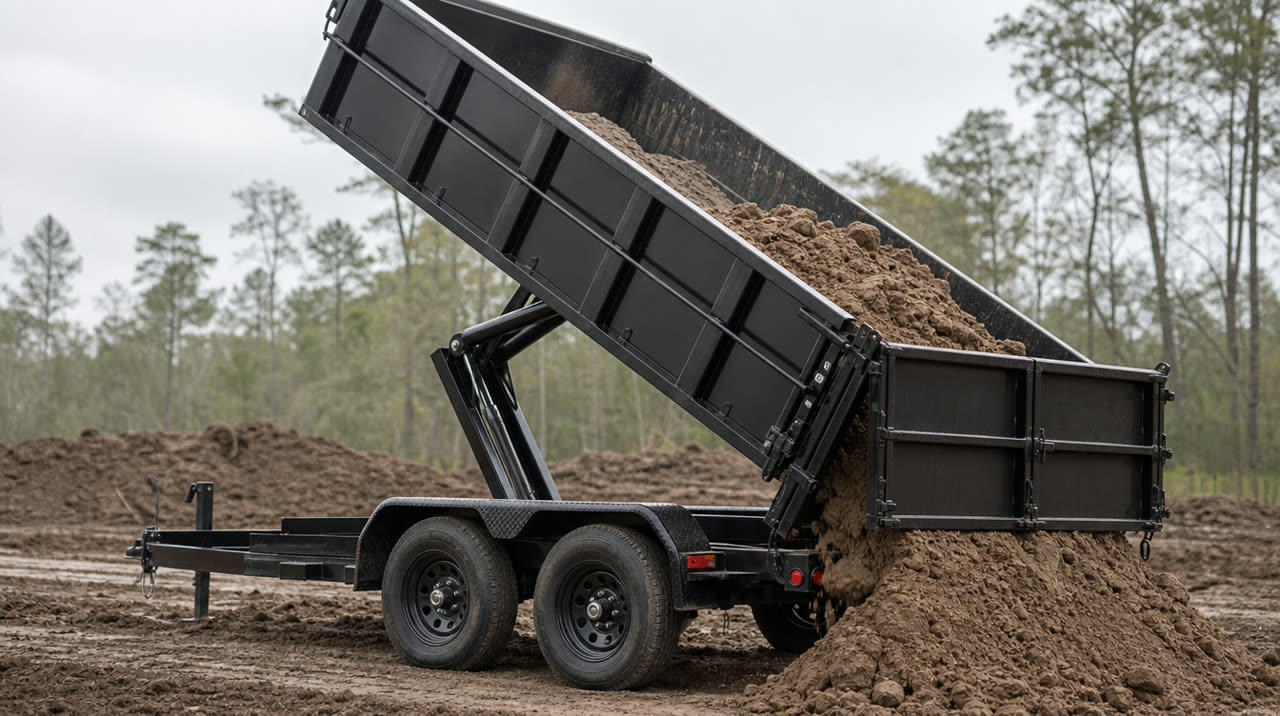
The part of a dump trailer nobody looks at until it quits
Park two dump trailers side by side, one with a scissor hoist and one with a telescopic cylinder. You cannot tell from the outside which one will empty a bed of wet Vermilion Parish clay in one lift and which will leave a third of it packed against the front wall.
The difference is under the bed: the hoist. Every dump trailer sold in Acadiana uses one of two designs, a scissor hoist or a telescopic cylinder. Both are hydraulic, both run off a 12-volt pump and a battery, and both dump dry mulch without complaint. They part ways once the load gets heavy, wet, or sticky, which here is most of the year.
How a scissor hoist works
A scissor hoist is a set of linked steel arms under the bed, roughly mid-trailer. One short, fat hydraulic cylinder pushes the arms open like scissors, and the arms push the bed up around its rear pivot. On Load Trail's DL low-pro line, the standard hoist is a 5-inch by 15.75-inch cylinder on the 10K through 16K models and a 6-inch by 21-inch on the 21K, each listed "w/Scissor Hoist" on Load Trail's spec sheet.
The linkage is a lever. It multiplies the cylinder's push at the start of the lift, the hardest moment, when the bed is flat and nothing has started sliding. That is why scissor hoists are known for breaking a heavy load loose and staying stable, with the weight spread across the linkage instead of hanging on one pin at the nose.
The trade-off is reach. The arms fold flat and run out of travel sooner. Load Trail rates its scissor-equipped DL at a 40-degree dump angle; its heavier lines are rated 45 to 50 degrees in the same brochure.
How a telescopic cylinder works
A telescopic hoist is one long cylinder with several stages nested inside each other, mounted at the front of the bed near the headboard. Pressure pushes the biggest stage out first, then the smaller ones, and the bed rises with it. Builders that design around it, like Diamond C (whose dump trailers we do not stock), advertise a "full 45-degree lifting angle" and note the cylinder comes out with "just two quick-release pins" for service.
Because the cylinder pushes straight up on the nose, it has no folding arms and no reach limit, which is where the steeper angle comes from. The cost is that the biggest stage does the first part of the lift and each smaller stage has less push, so the hoist weakens as the bed rises. The other cost is complexity: more stages, more seals, more sliding surfaces to keep clean.
Dump angle: the number that matters more than the name
Dump angle is how far the bed tips before it hits the stops. A steeper angle empties sticky material with less shoveling; that is the whole argument for telescopic, and it is a real one. But read the spec sheet, not the label, because Load Trail publishes 40 degrees on the scissor DL and 45 to 50 on scissor-equipped heavier lines.
| Load | Weight per cubic yard | Scissor at 40 degrees | Telescopic at 45 degrees |
|---|---|---|---|
| Dry wood mulch | 400 to 700 lb | Empties clean | Empties clean |
| Wet mulch or leaves | 800 to 1,000 lb | Empties, may need a rake | Empties clean |
| Wet topsoil | 2,700 to 3,000 lb | Slides once it breaks loose | Slides sooner |
| Wet clay (our gumbo) | 2,500 to 3,000 lb | Sticks; expect to shovel the nose | Sticks less; may still need help |
| Gravel or limestone | 2,700 to 3,400 lb | Empties clean | Empties clean |
| Broken concrete | 2,400 to 3,000 lb | Empties clean | Empties clean |
Weights are from a published cubic-yard chart, rounded; yours will vary with moisture. Notice the pattern: loose, free-flowing loads do not care which hoist you have. The angle only earns its money on sticky loads.
Wet clay and cane-country loads
South Louisiana is the worst case for a hoist. The clay under Lafayette, St. Martin, Iberia, and Vermilion parishes is dense, holds water, and packs against the front wall of a bed. A yard of it wet is about a ton and a half, so a 16-foot bed with 3-foot sides hits the axle rating on a 14K trailer well before it looks full. Empty weight on the build sheet matters as much as the hoist.
Then there is cane season. Louisiana grows sugarcane on more than 400,000 acres in 22 parishes, about 13 million tons a year per the American Sugar Cane League, and the LSU AgCenter puts the harvest at mid-September through mid-January. Farm crews and their contractors haul field-road rock in, haul mud and cane trash out, and rebuild headlands between rains. That mud is the stickiest load a dump trailer sees all year, and a steep angle, a power-down pump, and a gate you can open from the side are worth more in November than in July.
Hurricane cleanup is the opposite problem: limbs, fence, and wet drywall are light but they snag, so a wide barn-door gate matters more than angle. Either hoist handles the weight.
Maintenance in Acadiana humidity
Before you blame the hoist, check the cheap parts. A 12-volt dump has three things that can stop it lifting: the battery, the wiring between the battery and the pump, and the hydraulics. Check them in that order, cheapest first.
- Battery and charger. The pump pulls heavy amps for seconds at a time, and a trailer that sits between jobs lets the battery drift down. Load Trail ships the DL with a 12-volt battery and a 5-amp trickle charger; a solar charger is a factory option. Whatever you buy, keep it on a charger when parked.
- Connections. Humidity eats terminals. Dielectric grease on the posts and pump terminals, and check the ground strap. A corroded ground is a common reason a dump will not lift, and it is a five-minute check before anyone touches the hydraulics.
- Scissor upkeep. Grease the linkage pins on a schedule, keep the rod clean, and watch for weeping at the rod seal. Few moving parts is why it earns its low-maintenance reputation.
- Telescopic upkeep. Wipe every stage down; grit on an extended stage gets dragged through the seal and scores the tube. An oil film on a stage after a cycle means a seal is going. The cylinder is pinned at both ends and comes out without pulling the bed apart.
- Both. Check reservoir fluid with the bed down, cycle the hoist every few weeks even when idle, dump on level ground, never leave the bed up in wind.
Also know gravity-down from power-down. Load Trail's standard DL pump is a "12v Dual Acting Hydraulic Pump w/Manual Gravity Down Valve": open the valve and the bed settles under its own weight. Power-down (Load Trail lists a wireless remote with a dual-acting system as an option) pushes the bed down hydraulically, which helps an empty bed in wind or a bed stuck partway. Ask which you are getting.
What Falcon and Load Trail actually put under the bed
We sell two dump lines, Falcon and Load Trail, and they answer this question two different ways. Today the Falcon is the one physically on the lot; Load Trail dumps are built to order, figure roughly seven to nine weeks from the factory.
Load Trail publishes everything. The DL low-pro bumper-pull ships with a scissor hoist standard, a 10-gauge smooth-plate floor, 24-inch sides (36 and 48 available), a 2-way spreader gate, a 29-inch deck height, and a 40-degree dump angle across 9,990 to 21,000 lb GVWR, with base weights of 3,537 to 5,701 lb. A telescopic cylinder is a listed option on the same page, so you can order the DL either way.
Falcon does not, at least not online. Falcon Trailer Works has built trailers in Tyler, Texas for decades and lists Bumper Dump and Gooseneck Dump models, but both pages currently read "Specs Coming Soon!" with no hoist, floor, or angle published. Falcon's written warranty is one year on materials and workmanship and ninety days on electrical components, axles, bearings, and running gear; it excludes tires, axles, suspension, and "any other equipment that is warranted separately by the respective manufacturers." The pump and cylinder are not named either way, which is why question 7 below is on the list.
What we can say about Falcon comes from the build sheet on the unit in our yard: a 16-foot tandem-axle with 3-foot sides, two 7,000 lb axles, a 14,000 lb GVWR, and a 4,800 lb empty weight, which leaves about 9,200 lb of payload, roughly three yards of wet clay. The sheet lists a "620" ram hoist, plus a 2-way gate, slide ramps, tarp kit, 10K jacks, and a spare. In hoist-kit catalogs the 620 is the cylinder size: RAM Trailer Products sells its RH-CY-620 as a 6-inch by 20-inch stroke cylinder with a scissor hoist, and every 620 kit we found, RAM's and Johnson Trailer Parts' PH620 alike, is sold as a scissor hoist. The surest check is the one we use: raise it in the yard and measure it.
What to ask on the lot
- Scissor or telescopic, and what cylinder? Bore and stroke are on the build sheet.
- Dump angle in degrees? Then have them raise it empty and watch where it stops.
- Gravity-down or power-down? Wired remote, wireless, or both?
- What battery and charger? Trickle, solar, or none. None means you buy a charger this week.
- Empty weight? GVWR minus empty weight is payload; divide by 3,000 for yards of wet clay.
- Gate style. Spreader gates meter gravel; barn doors clear limbs.
- Who warranties the pump and cylinder, and for how long?
- Can I see one raised with a load on it? A demo settles more than any spec sheet.
Which one should you buy?
Rock, sand, and demolition: buy on price, payload, and gate, because either hoist empties those loads. The Falcon on our lot fits, and so does a scissor-hoist Load Trail DL on order.
Dirt contractor, cane-farm crew, or landscaper moving wet clay all winter: spend the money on angle. Order the Load Trail DL with the telescopic option, and while it is being built, come raise the Falcon on our lot with a load in it and see how much stays in the nose; that is the baseline the telescopic cylinder has to beat.
Either way, buy the trailer whose empty weight and GVWR match your truck. The best hoist in Louisiana cannot fix an overloaded axle.
Come raise a bed in Lafayette
The Falcon 16-foot 14K dump is on the lot now with live pricing on our inventory page, and we can order a Load Trail DL with the scissor hoist or the telescopic option. Coming soon shows what Load Trail physically has on a truck to us; a dump built to your spec is ordered separately, so text us rather than waiting on that page. If you would rather make payments, financing and rent-to-own are available on either brand. Text us at 337-279-2620 with what you haul and how wet it usually is, and we will tell you which hoist to buy, raise the Falcon for you when you get here, and quote the Load Trail build. Delivery is free within 50 miles of Lafayette. Ragin Trailers, 2601 SE Evangeline Thruway, Lafayette, LA 70508, 337-504-3820, ragintrailers@yahoo.com, family-owned since 2016.
Sources
- https://loadtrail.com/listings/dl-bumper-pull-dump/
- https://loadtrail.com/wp-content/uploads/2024/02/2023-Dump-Trailers-Brochure_LoRes.pdf
- https://loadtrail.com/dump/
- https://falcontrailers.com/catalog/trailers/dump-and-tilt/
- https://falcontrailers.com/catalog/trailers/dump-and-tilt/bumper-dump/27
- https://falcontrailers.com/catalog/trailers/dump-and-tilt/gooseneck-dump/30
- https://falcontrailers.com/warranty.php
- https://falcontrailers.com/
- https://www.diamondc.com/telescopic-cylinder-vs-scissor-hoist/
- https://brechbilltrailers.com/blog/other/telescopic-cylinder-scissor-hoist/
- https://mirageinc.com/hoist-comparison-scissor-vs-telescopic/
- https://topshelftrailers.com/scissor-lift-vs-telescopic-dump-trailer/
- https://ramtrailerproducts.com/product/hydraulic-scissor-hoists/
- https://johnsontrailerparts.com/shop/10-ton-hydraulic-scissor-hoist-kit-ph620/
- https://cubicyardestimator.com/guides/cubic-yard-weight-chart/
- https://www.amscl.org/education/sugar-industry-information/
- https://www.lsuagcenter.com/articles/page1757000182158
- https://www.lsuagcenter.com/topics/crops/sugarcane/sugarcane-farmers-finish-good-harvest-season
- Unit-level specs for the Falcon dump we stock (GVWR, empty weight, hoist, gate, sides) come from our own listing at ragintrailers.com/inventory.html.