Non-CDL Gooseneck Limits in Louisiana: The 26,001 lb Rule
The short answer
If the truck and trailer are used for a business, add the truck's GVWR to the trailer's GVWR. Land on 26,001 lb or more with a trailer rated over 10,000 lb and you need a Class A CDL. A 24,000 lb gooseneck behind any one-ton pickup clears that bar empty. Stay under 26,001 lb combined and Louisiana lets you run it on a Class D chauffeur's license, plus a USDOT number and a medical card if you cross state lines. Farmers with a clean record hauling their own product within 150 miles of the farm, and anyone towing for purely personal use, can do it on a plain Class E.
Everything below comes from the federal regulations, Louisiana R.S. 32:408 and DOTD's 2025 truck regulations booklet; where we could not verify a rule we say so.
Read this first. We sell trailers; we do not issue licenses. This is a dealer's reading of the rules as of September 2026, not legal advice. Before you buy a truck or trailer around a license class, confirm your situation with the Louisiana Office of Motor Vehicles (expresslane.la.gov or the Lafayette OMV office) and, for DOT questions, Louisiana State Police commercial vehicle enforcement.
The two federal numbers that decide it
The CDL rule is 49 CFR 383.5. A Group A (Class A) commercial motor vehicle is a combination "having a gross combination weight rating or gross combination weight of 11,794 kilograms or more (26,001 pounds or more), whichever is greater, inclusive of a towed unit(s) with a gross vehicle weight rating or gross vehicle weight of more than 4,536 kilograms (10,000 pounds), whichever is greater."
Three catches:
- Both numbers have to hit. A 14,000 lb trailer behind a truck plated at 10,000 lb is 24,000 lb combined and is not a CDL combination.
- GCWR is not the sticker in your door. The same section defines GCWR as the greater of the manufacturer's rating or "the sum of the gross vehicle weight ratings" of truck and trailer. That sum is your number.
- "Whichever is greater" means actual weight counts too. Run a light-tagged trailer heavy and the scale, not the tag, decides.
The second number is 10,001 lb, and it is not about your license. 49 CFR 390.5 defines a commercial motor vehicle in interstate commerce as any vehicle or combination rated or weighing "10,001 pounds or more." Cross that line for business across a state line and the federal safety rules apply whether or not you hold a CDL.
What that means for a 24K gooseneck behind a one-ton
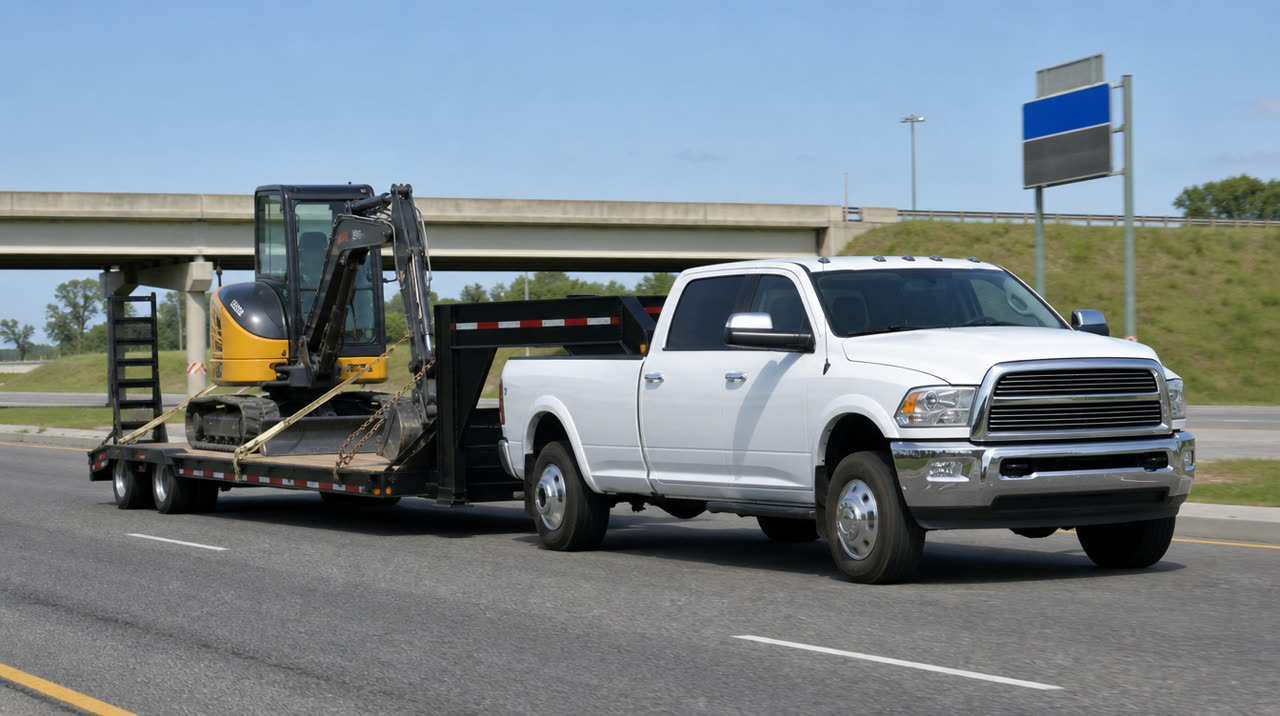
Take the Load Trail GP0230 on our September truckload: a 102-inch by 30-foot low-pro gooseneck on two 10,000 lb Dexter axles with duals, plated at 24,000 lb GVWR. Load Trail builds the GP line at 22,000, 24,000 and 30,000 lb.
Now add any one-ton pickup. The trailer is already 24,000 lb of the 26,001, so the truck only has to be rated at 2,001 lb to make it a Class A combination, and every pickup ever built is. If the trip is for a business, it is a Class A trip. Louisiana Farm Bureau's compliance guide uses almost this exact rig, a one-ton dually and a dual-tire gooseneck at 32,000 lb combined, as its example of a "Class A CDL type vehicle."
Louisiana's license classes, in plain English
Louisiana R.S. 32:408 sets the classes, and DOTD reprints them on page 75 of its 2025 booklet:
| Class | What it covers | Who this is in Acadiana |
|---|---|---|
| A (CDL) | Combinations rated 26,001 lb or more with a towed unit rated over 10,000 lb | Hotshotters pulling 22K to 30K goosenecks for a business |
| B (CDL) | Single vehicles rated 26,001 lb or more, towing 10,000 lb or less | Dump trucks, not pickups |
| D (chauffeur's) | Single vehicles or combinations rated 10,001 to 26,000 lb "used in commerce" | The non-CDL hotshot: SRW truck plus a 14K or 16K gooseneck |
| E (personal) | Single vehicles under 10,001 lb, "any personal use of recreational vehicle or combination of vehicles," and farm vehicles within 150 miles of the farm | Camp, hunting lease, the family farm |
Two statute lines matter most. First: "A commercial driver's license shall be required when a vehicle is used in commerce as defined in this Chapter, and is a commercial motor vehicle as defined in this Chapter." Second, the Class D line: a pickup rated under 10,001 lb pulling a 14K gooseneck for a business is a 24,000 lb combination used in commerce, and that takes a Class D, not the Class E in your wallet.
"Non-CDL" is not "no paperwork"
The checklist for a sub-26K commercial gooseneck:
- Class D chauffeur's license (R.S. 32:408) for 10,001 to 26,000 lb combined, used in commerce.
- USDOT number if you haul across state lines at 10,001 lb or more; 49 CFR 390.19T requires the MCS-150 filing and a biennial update, and FMCSA deactivates numbers that skip it. For-hire freight across state lines also needs operating authority (49 CFR Part 365).
- Medical examiner's certificate. 49 CFR 391.41(a)(1)(i): "A person subject to this part must not operate a commercial motor vehicle unless he or she is medically certified as physically qualified to do so," and the sentence goes on to require that the certificate be carried on duty. A 10,001 lb rule, not a CDL rule.
- Hours of service. Non-CDL drivers who stay within a 150 air-mile radius of their base and finish within 14 hours (16 on two days a week) can use the short-haul exception in 49 CFR 395.1(e)(2).
The setups hotshotters actually run without a CDL
The whole game is truck GVWR plus trailer GVWR at 26,000 lb or under. Do the math from your door-jamb label:
| Your truck's door-jamb GVWR | Trailer that keeps you at or under 26,000 lb | Load Trail model that fits |
|---|---|---|
| 10,000 lb or less | Up to 16,000 lb | GC16 gooseneck car hauler: two 8,000 lb Dexter axles, 16,000 lb GVWR |
| 10,001 to 12,000 lb | Up to 14,000 lb | GC14 gooseneck car hauler: two 7,000 lb Dexter axles, 14,000 lb GVWR |
| Over 12,000 lb (most duallies) | Under 14,000 lb, and the math gets tight | Talk to us first; a dually usually means a Class A rig anyway |
Load Trail's GC line runs 16 to 40 feet on a 6-inch channel frame with a 12-inch I-beam neck. The 24K and 30K goosenecks on our lot are Class A trailers. A GC14 or GC16 is not on the lot today; it is built to order, typically 6 to 8 weeks from the factory, and we will quote the build.
Three habits:
- Order it plated at the number you need. The factory certification label is the GVWR. Do not plan on "derating" a heavier trailer with a sticker later; Louisiana's CDL flow chart notes that when the GVWR cannot be determined, actual gross weight may be used.
- Know your real payload. Payload is GVWR minus empty weight, and a 30-foot gooseneck weighs plenty empty; our 30K unit lists at 8,850 lb. For a 14K or 16K build, check the build sheet.
- Measure the whole rig. Louisiana's no-permit limits are 102 inches wide, 13 feet 6 inches tall off the interstate (14 feet on it) and 65 feet for a two-vehicle combination. A crew-cab long-bed with a 40-foot gooseneck is close; measure it hitched.
Farm exemptions: what the family farm actually gets
49 CFR 383.3(d)(1) lets a state waive the CDL for a farm vehicle controlled and operated by a farmer (employees and family included), used to move agricultural products, farm machinery or farm supplies to or from a farm, not used for hire, and used within 150 miles of the farm. Louisiana took that waiver in R.S. 32:408(A)(8)(b) almost verbatim, and DOTD lists those farm vehicles under Class E. The strings attached, in R.S. 32:408(A)(8)(b)(i) and (ii), are tighter than most farmers assume:
- You must already hold a license. A first-time applicant is not eligible.
- The look-back is two years if you have driven more than two, and your whole history if you have driven one to two.
- "Satisfactory operating record" is narrow: not more than one license; no license suspended, revoked or canceled; no disqualifying or serious traffic conviction under R.S. 32:414.2; no conviction of "a state or local law relating to traffic control, other than a violation arising in connection with a traffic accident"; and no at-fault accident.
Read that plainly. A routine speeding ticket inside the window is a traffic-control conviction, and the statute does not carve it out; as we read it, that farmer does not qualify for the Class E exemption, however the rig is plated. The OMV makes the call, not us.
On top of that sits the federal covered farm vehicle rule in 49 CFR 390.5 and 390.39. A truck and trailer registered with a farm plate, operated by the farm's owner, family or employee, hauling farm goods, livestock, machinery or supplies, and not for hire, is exempt from the CDL, drug-testing, medical-card, hours-of-service and inspection rules. At 26,001 lb or less that holds anywhere in the country; over 26,001 lb it holds inside Louisiana and within 150 air miles of the farm across state lines.
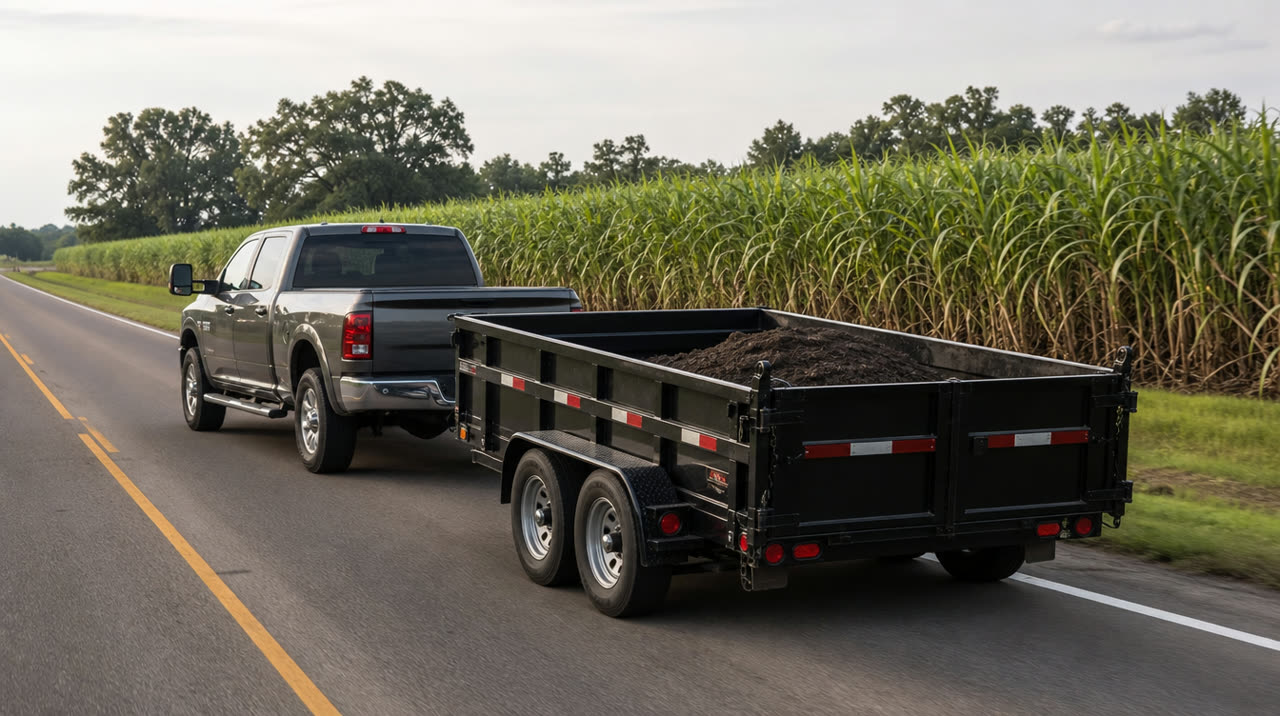
So a cane farmer in Iberia Parish with a clean two-year record, hauling a tractor to a field in St. Mary on a 24K gooseneck behind a farm-plated dually, is fine on a Class E. The same rig loses every exemption the moment the farmer hauls a neighbor's equipment for a fee, runs past 150 air miles, or carries anything that is not farm product, machinery or supplies.
Which buyer are you?
- Sugarcane, rice, crawfish or cattle, within 150 miles, on farm plates, with a clean record: any gooseneck we sell, on the license you have, as long as it stays farm-only.
- Hotshot or contractor who will take real weight: buy the 24K or 30K, hold the Class A and run the DOT file.
- Hotshot or contractor staying non-CDL: SRW truck, GC14 or GC16 built to order, Class D, USDOT number, medical card, 150-mile lanes.
- Personal use only: Class E and any trailer your truck is rated to pull. Run our towing check before you assume it is.
Come see the goosenecks in Lafayette
The 30K low-pro gooseneck is on the lot now with live pricing on our gooseneck inventory page, and the 24K GP0230 is on the September Load Trail truckload on coming soon, where you can reserve it. Financing is available on either one. Text 337-279-2620 with your truck's door-jamb GVWR and what you plan to haul, and we will tell you straight whether you are shopping for a Class A trailer or a 14K. Then confirm the license class with the OMV before you sign. Delivery is free within 50 miles of Lafayette, and we are at 2601 SE Evangeline Thruway, family-owned since 2016.
Sources
- https://www.law.cornell.edu/cfr/text/49/383.5
- https://www.law.cornell.edu/cfr/text/49/383.3
- https://www.law.cornell.edu/cfr/text/49/390.5
- https://www.law.cornell.edu/cfr/text/49/390.39
- https://www.law.cornell.edu/cfr/text/49/390.19T
- https://www.law.cornell.edu/cfr/text/49/391.41
- https://www.law.cornell.edu/cfr/text/49/395.1
- https://www.law.cornell.edu/cfr/text/49/365.101
- https://codes.findlaw.com/la/revised-statutes/la-rev-stat-tit-32-sect-408/ (Louisiana R.S. 32:408, FindLaw copy current to January 1, 2023)
- https://dotd.la.gov/media/2u4lj431/rules-and-regulations-1.pdf (Louisiana Regulations for Trucks, Vehicles, and Loads, DOTD 2025 edition, pp. 7-12 and 71-75)
- https://expresslane.la.gov/omv/drivers/commercial-driver-s-licenses-cdl/
- https://expresslane.la.gov/omv/resources/omv-policy/vehicle-license-plate-classifications-requirements/
- https://public.powerdms.com/ladpsc/documents/366390 (OMV Policy 70.00, Louisiana Agriculture License Plates)
- https://static1.squarespace.com/static/50071d3fe4b002842b318854/t/5dc0a5f9a8be4d5188804eba/1572906490767/A+Louisiana+Guide+to+Farm+Vehicle+Compliance+10-22-19+2.pdf (Louisiana Farm Bureau Federation, revised 10/2019)
- https://loadtrail.com/listings/gp-low-pro-gooseneck-deckover-2/
- https://loadtrail.com/listings/gl-low-pro-deckover-w-hyd-dove/
- https://loadtrail.com/listings/gc-channel-gooseneck-car-hauler-2/
- Unit-level specs for the trailers we stock (GVWR tags, axles, empty weights) come from our own listings at ragintrailers.com/inventory.html.